How the Instant Asset Write-Off Works for Farmers
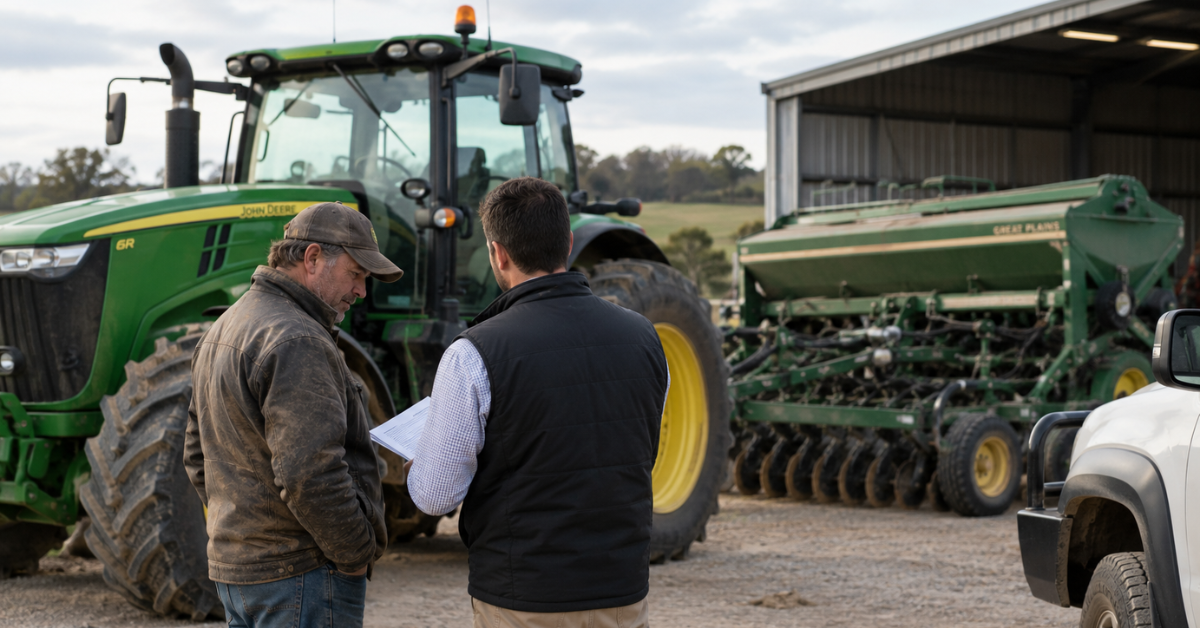
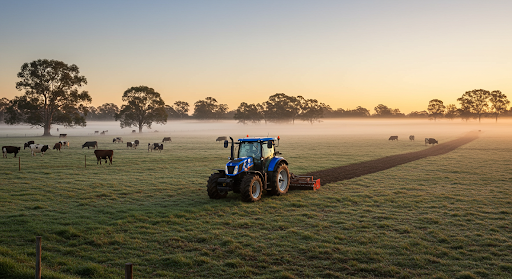
Farm assets rarely fail at a convenient moment. The pump gives out midway through a dry spell, the yards need rebuilding before weaning, and the right secondhand tractor turns up at a clearing sale months before you sell a line of steers.
The instant asset write-off is one of the few tax rules that lines up with how farms operate. It lets eligible farm businesses claim the full cost of a qualifying asset in the year they start using it, instead of spreading it across ten or twenty years.
That timing difference matters for cash flow. This article covers what qualifies on an Australian cattle or dairy operation, the farm deductions most producers overlook, and how farm machinery finance lets you claim now while paying the asset off over time.
The Real Problem Is Timing, Not Tax
Your income arrives in lumps. Cattle sales, milk cheques and grain payments land at set points in the year, and rarely when equipment fails.
Asset purchases do not follow that rhythm. A blown irrigation pump in February will not wait for the autumn sale. The squeeze is familiar: pay cash and head into the next feed bill with a thin account, or defer and wear the cost in downtime, contractor hours and lost labour efficiency.
A deduction only helps if you have profit to offset. ABARES forecasts average farm business profit to fall in 2026-27, with the value of livestock production down on the previous year. In a tighter season, the write-off is worth planning around rather than rushing to beat 30 June.
Producers also lose the benefit through the wrong finance structure. Under a rental agreement or an operating lease, the financier owns the asset. You deduct the payments instead, so the instant asset write-off is not available at all.
The cost of getting this wrong is not paperwork. It is a deduction you were entitled to and missed.
How the Instant Asset Write-Off Works on Farm Assets
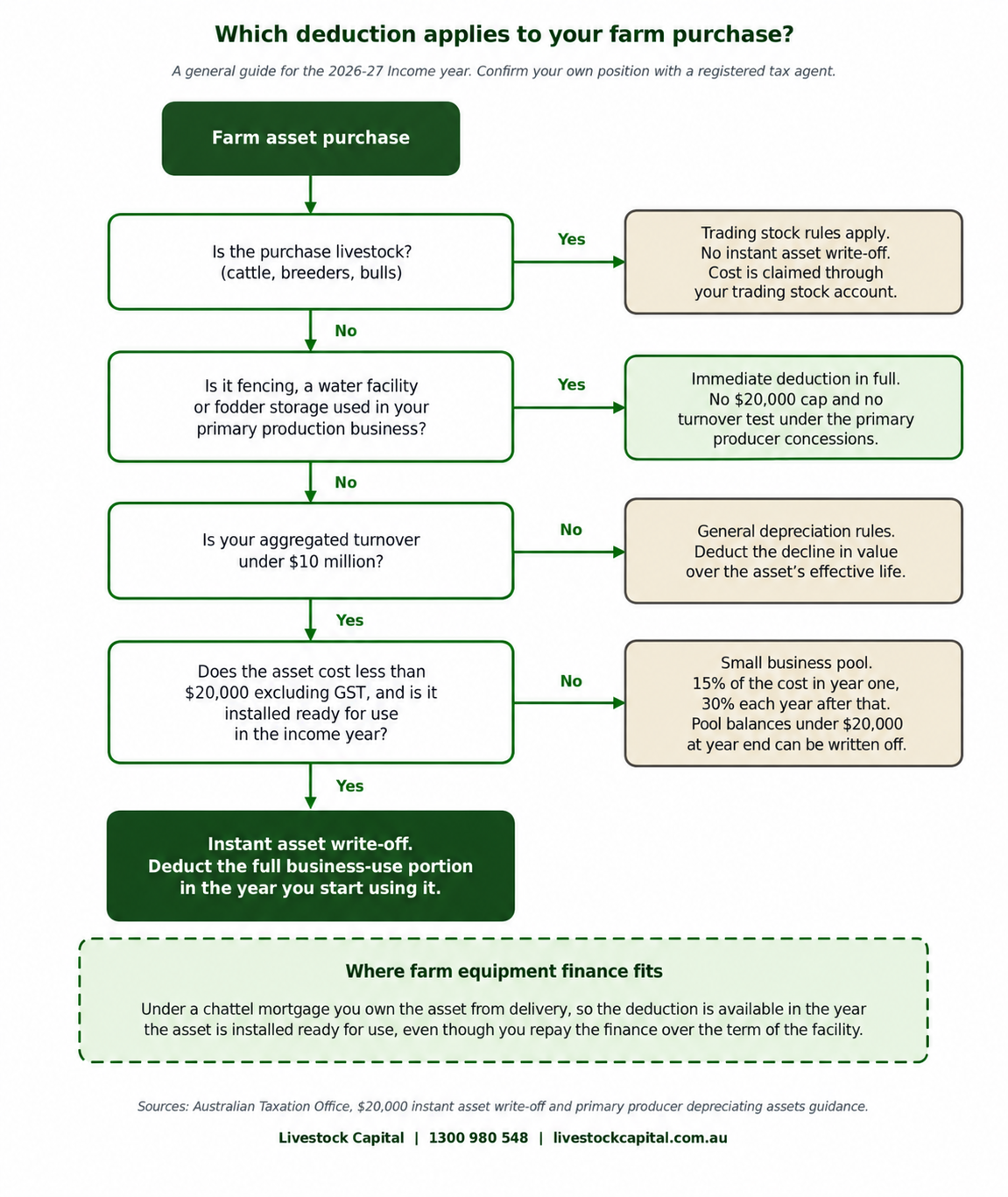
The rules are more settled than they used to be. The $20,000 instant asset write-off is now permanent from 1 July 2026, so the annual guessing game is over.
What has to line up:
- Your aggregated turnover must be under $10 million, including connected and affiliated businesses.
- The asset must cost less than $20,000, excluding GST if you are registered.
- The limit applies per asset, not to your total spend. Three items at $18,000 each are all deductible in full.
- The asset must be first used or installed ready for use during the income year. Ordering it is not enough.
- You claim the business-use portion only, and both new and secondhand assets qualify.
Anything costing $20,000 or more goes into the small business pool instead, deducted at 15% in the first year and 30% each year after. Pool balances under $20,000 at year end can be written off.
Two traps catch farmers. A trade-in does not reduce the cost for threshold purposes: trading a header for $12,000 against a $28,000 replacement still leaves a $28,000 asset. The car limit of $69,883 also caps depreciation on passenger vehicles, though most one-tonne farm utes sit outside it
The Farm Deductions That Are Not Capped at $20,000
This is the part most producers miss. Primary producers have their own concessions that sit outside the $20,000 threshold entirely.
Fencing, water facilities and fodder storage assets used in a primary production business on land in Australia are immediately deductible in full, whatever they cost. There is no $20,000 cap and no turnover test.
That covers:
- Boundary and internal fencing, including repairs of a capital nature.
- Dams, tanks, bores, pumps, troughs, pipes and irrigation channels.
- Silos, hay sheds and grain storage used primarily to store fodder.
A $90,000 fencing and water reticulation program does not go near the small business pool. It comes off this year's income in full. For a beef producer subdividing paddocks for rotational grazing, that changes the investment case.
Conditions apply. You must be carrying on a primary production business; secondhand water facilities and fodder storage assets are generally excluded; and partnerships allocate the deduction to individual partners.
Livestock is trading stock, not a depreciating asset, so buying cows or bulls does not attract the write-off. That cost flows through your trading stock account instead. If herd growth is the plan, cow finance and beef finance are built for that and work differently.
Using a Chattel Mortgage to Claim Now and Pay Over Time
A chattel mortgage is the structure most farm machinery finance sits on, and it is why finance and the write-off pair well.
Under a chattel mortgage you own the asset from delivery. The financier registers security over it until the facility is repaid. Because you are the owner, the deduction is available in the year the asset is installed ready for use, even if only one repayment has been made by 30 June.
The cash flow effect is the point. You put in little or nothing upfront, the asset starts earning immediately, and the deduction lands the same year.
Three further benefits:
- If you are registered for GST on an accrual basis, you can generally claim the GST credit on your next BAS, not across the loan term.
- The interest portion of your repayments is deductible.
- Repayments can be structured around your income cycle instead of a flat monthly schedule.
“Producers often think they have to choose between preserving cash and claiming the deduction. Under a chattel mortgage you get both, because ownership passes to you on delivery. We see farmers hold off on a purchase that would pay for itself in a season, when the right structure would have let them claim it in full this year.” - Mark Smith, Livestock Capital
Our guide to farm equipment finance types compares chattel mortgages with leases and rentals in more detail.
Getting the Timing and the Paperwork Right
Installed ready for use is the phrase that decides your claim. A tractor invoiced on 28 June but delivered in July belongs to the following income year.
Machinery lead times run to weeks or months, so if you are working towards 30 June, plan backwards from delivery, not the invoice. Sort the finance before the sale, not after. Livestock Capital typically approves equipment finance within 72 hours of a complete application, enough to bid with confidence at a clearing sale.
Keep on file for at least five years:
- The tax invoice and your finance contract.
- Evidence of the delivery or installation date.
- A reasonable basis for your business-use percentage.
One caution. A deduction is not a discount. A $19,000 purchase reduces taxable income by $19,000, saving tax at your applicable tax rate, not the full amount. Buy the asset because your operation needs it and speak to a registered tax agent before you commit.
Signs Your Farm Should Act on This Now
Indicators it is time to stop deferring:
- You are running machinery past its useful life and paying for it in downtime, repairs and contractor rates.
- Fencing or water infrastructure is limiting your carrying capacity, and the job keeps getting pushed back.
- You paid cash for a major asset last year and felt the pinch all season.
- You have walked away from equipment at a clearing sale because approval would not come in time.
- Your current agreement is a rental or operating lease and you have never checked what that means for deductions.
Delay has its own cost. A water upgrade deferred through a dry summer costs more in agistment, cartage and lost condition than the deduction was worth. If a larger land base is also on the table, farm land finance and equipment funding are best planned together.
How Livestock Capital Approaches Equipment Finance
Livestock Capital finances farm equipment for Australian producers nationwide, from Victorian dairy operations to northern beef enterprises and feedlots.
We assess your operation as a whole rather than micro-managing individual assets. No per-head tracking, no monitoring reports, no surprise conditions buried in the documents.
The process runs in four steps:
- An obligation-free discussion about the asset and how it fits your operation.
- A tailored proposal covering structure, term and repayment timing.
- Credit assessment, typically within 72 hours.
- Documentation and settlement, then delivery.
Most equipment facilities are written with no deposit required, using the equity already in your agricultural assets. Terms are structured around your income cycle, whether that is a monthly milk cheque or two cattle sales a year. We are not tax advisers, so run the numbers past your accountant.
Our job is making sure the finance structure does not get in the way of a deduction you are entitled to.
Quick Checklist Before You Buy
- Confirm your aggregated turnover is under $10 million before relying on the threshold.
- Check whether the purchase is fencing, water or fodder storage, which are deductible in full at any cost.
- Ask your financier whether the structure gives you ownership from the day of delivery.
- Confirm delivery and installation dates in writing, not just the invoice date.
- Ask what deposit is required and how repayments are timed against your income cycle.
- Talk to a registered tax agent about your profit position before you commit.
Run these questions past your financier before you sign, not after delivery. Producers who get the most from this concession plan purchases at the start of the year, line up approval in advance, and buy when the operation needs the asset, not in the last week of June.
Plan Your Next Purchase Around the Instant Asset Write-Off
The instant asset write-off rewards producers who plan asset purchases rather than react to them. Paired with the right finance structure, the write-off lets you upgrade the machinery, fencing or water infrastructure your operation needs, claim the deduction this year, and keep working capital free for feed, freight and cattle.
Talk to Livestock Capital about your next purchase. Call 1300 980 548 or apply online, and visit our farm equipment finance page for facility options, eligible assets and the full application process.