Farm Loan Calculator Australia: Herd Expansion Budget
Half of Australian beef producers say they plan to grow their herd this year, and MLA's 2026 Cattle Industry Projections have the national herd holding above 30 million head on the back of strong global demand. If your operation is in that expansion group, the numbers you punch into a farm loan calculator will shape the next three to five years of your business.
Get the inputs right and the calculator gives you a realistic picture of what expansion actually costs. Get them wrong and you end up underfunded, chasing your tail on feed bills or forced to sell cattle at the worst possible time.
This guide walks through the inputs Australian cattle producers, dairy farmers and feedlot operators need to consider before committing to a herd expansion budget, so the number your calculator spits out actually reflects your operation.
Why Most Herd Expansion Budgets Fall Short
Most online loan calculators treat expansion as a single line item: cattle price multiplied by head count, divided over a term. That is not how a growing cattle operation works.
The Meat & Livestock Australia Beef Producers' Intentions Survey for 2026 found producer sentiment at an all-time high, with expansion driven mainly by retaining more heifers rather than buying in females. That kind of expansion locks up capital for years before those replacement females start paying their way, and that lag is exactly what a basic calculator misses.
The real cost of adding 200 breeders is rarely just the purchase price. Freight, agent fees, extra agistment, water infrastructure, supplementary feed through a dry patch and the wages of another set of hands can often add a significant amount on top of the sticker price. If your budget only covers the cattle, the operation is already stretched before the first calf hits the ground.
The producers who run into trouble usually share the same story. They use a generic loan calculator, borrow to the exact cattle cost, then hit a feed shortage or a slower-than-expected turn-off cycle. Cash flow tightens, repayments come due before income lands, and suddenly the expansion becomes a fire sale instead of a growth story.
The Inputs That Actually Matter in a Farm Loan Calculator
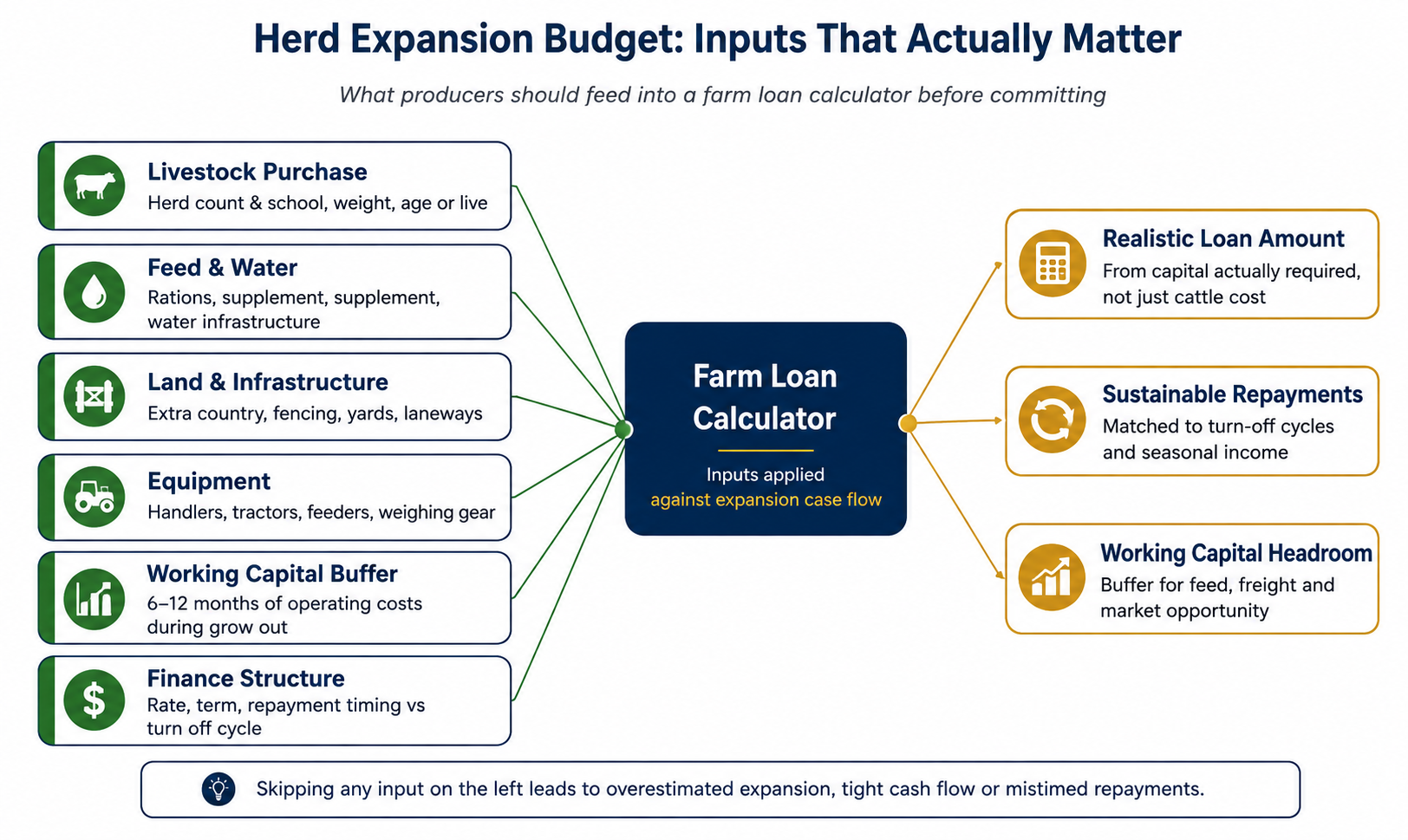
A farm loan calculator is only as good as what you feed it. The obvious inputs, loan amount, interest rate and term, are the easy ones. It is the operational inputs that determine whether the repayment schedule is survivable.
Before you settle on a loan amount, work through these numbers for your specific operation:
- Total capital required, including cattle, freight, agent commission and induction costs, not just the auction price.
- Deposit or equity available, and how much of that you actually want to lock into the expansion versus keeping as buffer.
- Interest rate reality, using a rate two to three percent above current offers to stress-test the budget.
- Repayment structure options, monthly principal and interest, interest-only for the grow-out period, or a facility limit you draw against as needed.
- Term matched to your production cycle, not just what the calculator defaults to.
The way you structure that finance matters as much as the rate. For more detail on how loan rates are set, see this guide
on what affects your farm loan rate.
Beyond Cattle Purchase: Feed, Land and Equipment Costs
Herd expansion is rarely a single-line purchase. Once you add head to the operation, everything downstream needs to scale with them, and each of those costs deserves its own row in your budget.
If you are adding country to carry more head, a land loan calculator gives you the repayment picture for the block itself, but land is typically financed over a longer term than livestock. Blending land and cattle finance in the same instrument can lock you into a structure that suits neither. Most Australian producers do better with farm land finance for the country and separate cattle finance for the herd itself.
Equipment is the other line most producers underestimate. A new set of yards, a bigger feed-out cart, an extra water trough system or an upgraded weighing crush can easily run to six figures once installed.
A farm equipment loan calculator run alongside your livestock numbers helps you see the true cost of expansion before you commit. Purpose-built equipment finance keeps that debt separate from your working capital facility, which protects your operational headroom.
Feed and water are the running costs that break tight budgets. If you are expanding into a season that turns dry, supplementary feed, agistment fees and freight to move stock can eat into a significant share of projected income. Build that scenario into the budget, not just the best-case one.
Cash Flow Timing vs Loan Repayment Cycles
A calculator that only shows a fixed monthly repayment ignores the single biggest reality of a cattle operation: income does not arrive monthly. It arrives when cattle are turned off.
For a breeder, that might be one or two major sales a year plus store cattle drafts. For a feedlot operator, it is a tighter cycle of intake and turn-off, but still lumpy. For a dairy farmer, milk cheques come monthly but capital returns from herd improvement play out over years.
The mismatch matters. A five-year principal and interest loan with equal monthly repayments will drain your account in the months before your first turn-off from the new stock. A facility that lets you draw down when you need to buy and pay down when cattle sell keeps cash flow aligned to the operation.
When you run any farm loan calculator, sketch your expected monthly income against the proposed repayment for at least the first eighteen months. If there are three or four months where repayments exceed inflows, you have either the wrong structure or the wrong term. That is the input the calculator will not surface for you, but it is the one that decides whether the expansion works.
Structuring Livestock Finance to Match Herd Expansion
Purpose-built livestock finance solves the timing problem that most generic farm loans create.
Rather than a fixed-repayment loan tied to a single purchase, a facility structure gives you an approved limit you can draw against as opportunities come up, whether that is a line of PTIC (pregnancy tested in calf) females at a clearance sale or a block of feeder steers that suit your paddocks.
Working capital is the other consideration. Feedlot operators in particular carry heavy inventory value between induction and turn-off. See this breakdown of feedlot working capital versus infrastructure finance for producers weighing up how to split that funding
The wider agricultural debt picture from ABARES shows beef producers now hold around 24 percent of Australian farm debt, and larger operators account for more than half of all borrowings.
What is telling is that farm equity levels are near 25-year highs, meaning most producers have the balance sheet strength to expand; they just need the right finance structure to unlock it without straining cash flow.
Signs Your Current Finance Structure Is Holding Back Expansion
A generic loan can work for a static operation. It struggles the moment you try to grow. Watch for these signals:
- Cattle opportunities pass you by while you wait weeks for loan approval on each purchase.
- Every drawdown triggers a fresh round of paperwork, valuations or per-head reporting to your lender.
- Your repayment schedule forces sales at the wrong time of year, rather than when the market is right.
- You are holding cash back from operations because you cannot get it back once it is put into the loan.
- Your facility limit was set at a size that suited last year's operation, not the expansion you are planning.
The cost of ignoring these signs is not always visible on a monthly statement. It shows up as the extra cattle you did not buy, the paddock you did not develop, or the truckload of feeder steers you passed on because the finance would not move in time. Over a season, that is real income you never earned.
How Livestock Capital Structures Herd Expansion Finance
Livestock Capital works with Australian cattle producers, feedlot operators and growing agricultural businesses across the country. The assessment focuses on how the whole operation performs, not on tracking individual head, which removes the reporting burden most producers dread.
Facilities are structured as a limit you can draw against and pay down as your operation dictates, rather than a one-off loan with a fixed schedule. That means you can act on a livestock opportunity within days instead of weeks, and repay when cattle sell rather than on a bank calendar that ignores your turn-off cycle.
Approval focuses on the practical picture of your operation, your track record and your expansion plan. Terms are transparent, with no hidden reporting requirements or surprise valuation costs mid-term. Livestock Capital serves cattle producers Australia-wide, from northern breeders to southern feedlot operators.
Quick Checklist: Getting Your Herd Expansion Budget Right
Before you finalise numbers with any lender, run through this checklist to make sure your budget reflects what a real herd expansion actually costs, not just the sticker price on the cattle. Each of these points has caught out producers who otherwise had a solid plan on paper.
- Include every real cost, not just cattle: freight, agistment, feed, water, fencing, equipment and wages.
- Build a working capital buffer of six to twelve months of operating costs into the total loan amount.
- Stress-test the repayment schedule against a dry season or a delayed turn-off, not just the base case.
- Ask any finance provider whether repayments can flex around your turn-off cycle, or if they are fixed monthly.
- Check whether the facility gives ongoing access to funds, or ties you to reapplication for every purchase.
- Confirm what reporting the lender expects: per-head tracking versus operation-level assessment makes a real difference to your time.
Working through each of these points before you speak to a finance provider means the conversation starts with a realistic picture of your operation. It also puts you in a stronger position to negotiate a facility structure that actually fits how your cattle earn, rather than accepting whatever the lender's standard product happens to look like.
Ready to Plan Your Herd Expansion the Right Way?
A farm loan calculator is a starting point, not a plan. The producers who expand successfully are the ones who fill in every real input, match the finance structure to how their cattle actually earn, and keep working capital available for the opportunities that always come up mid-season.
Livestock Capital can help you scope the right facility for your herd expansion goals, from cattle purchase through to feedlot finance for growing operations. Call
1300 980 548 to talk through your expansion plan, or apply online to get an assessment on your operation.