How Much Deposit Do You Need to Buy a Farm?
The block next door comes up for sale. The fences already line up with yours, the country is the type you have been chasing for a decade, and the agent mentions two other parties are circling. So you ring the bank, and the first question back is how much deposit to buy a farm of that size you have sitting ready.
That question stops more expansions than dry seasons do.
Traditional agricultural lenders work to a template: a large cash deposit, a full valuation, three years of financials and a credit committee that meets when it meets. By the time the answer lands, the property has sold.
Flexible farm land finance works differently. It looks at the whole operation, land, livestock, plant and income, then builds the deposit position out of equity already sitting in the business.
This guide covers what lenders actually ask for, how deposit ranges shift with property type, what sits beside the deposit at settlement, and how to buy country without draining the working capital your farm runs on.
What a Farm Deposit Really Means
A farm deposit is not a home loan deposit with more zeros. Lenders express it as a loan-to-value ratio, or LVR, which is the share of the property value they are prepared to lend against. If a lender offers 70% LVR, your deposit is the other 30%.
The valuation, not the price
Your deposit is worked out on the lender's valuation, not what you agreed to pay. Rural valuations regularly land under contract price, particularly on tightly held country where comparable sales are thin on the ground.
A $2 million purchase valued at $1.85 million on 70% LVR leaves you funding $705,000 rather than $600,000. That $105,000 gap has to come from somewhere, usually at short notice.
Commercial lending, not residential
Once land is income-producing, the loan is assessed as commercial finance. Lenders weigh farm earnings, existing debt against plant and livestock, off-farm income and how deep the resale market is for that country.
The more specialised the land, the more conservative the LVR. A dairy platform or single-purpose irrigation block is harder to move quickly, so lenders hold back more.
Why the old model costs producers
Traditional agricultural land finance adds time at every step. Full valuations, reporting schedules, security reviews and committee dates stretch a decision across weeks.
Good country does not wait that long. The real cost of a slow approval is the property you did not buy.
How Much Deposit Do You Need to Buy a Farm?
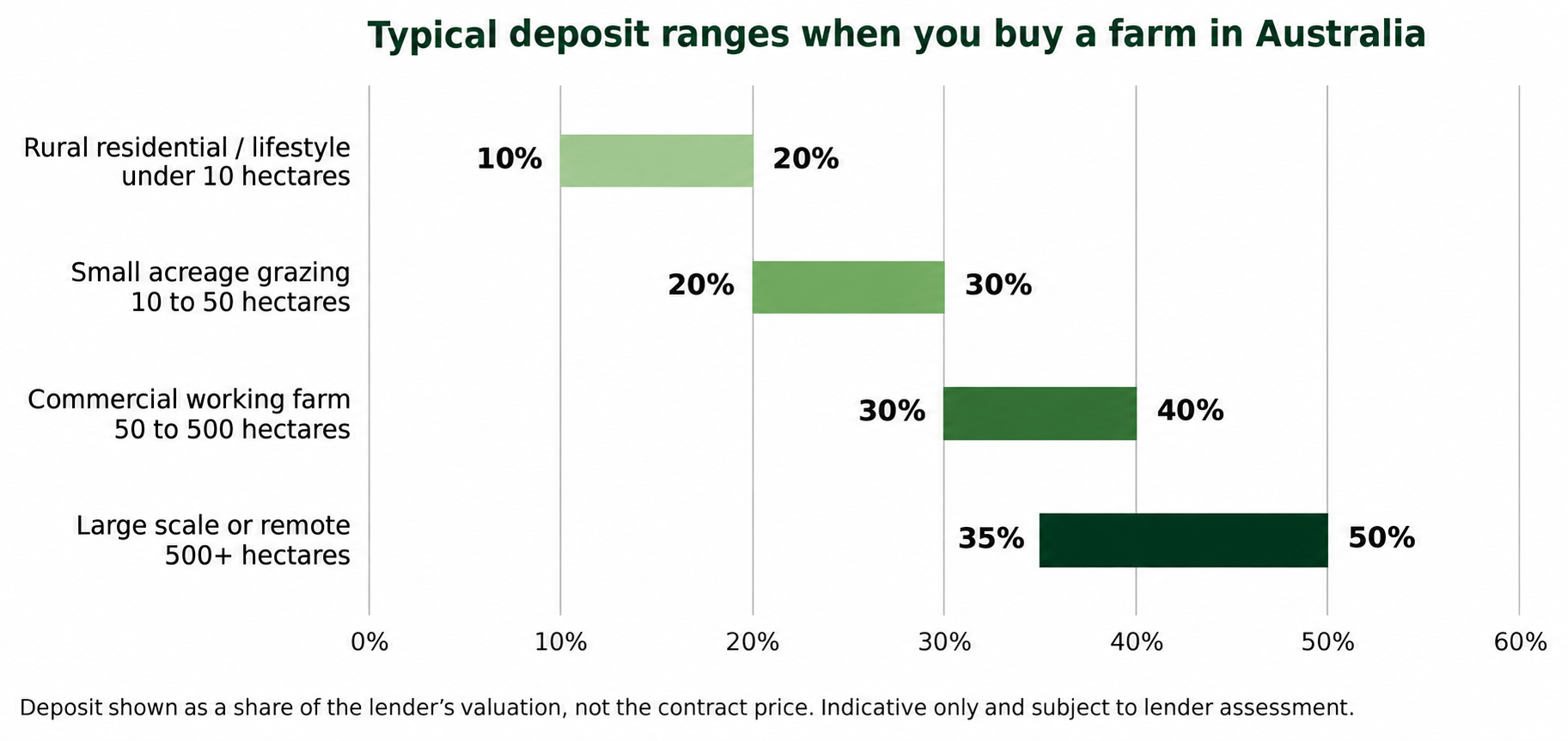
There is no single number, because lenders price risk by land type, size, location and how easily the property could be resold. The ranges below reflect what most Australian producers run into.
Rural residential and lifestyle blocks
Under roughly 10 hectares and close to a regional centre, the property is assessed much like a house. Deposits of 10% to 20% are common, and some lenders stretch the LVR further again where a dwelling carries most of the value.
Small acreage and grazing country
Between 10 and 50 hectares, plan on 20% to 30%. The land is no longer purely residential, so income potential and pasture quality start to matter to the assessment.
Commercial working farms
For a genuine production unit between 50 and 500 hectares, deposits of 30% to 40% are standard. Full business financials come into play and the loan is assessed on earnings, not equity alone.
Large-scale and remote holdings
Big or isolated country, single-purpose infrastructure and drought-exposed regions sit at the conservative end. Budget for 35% to 50%, and allow extra time for a valuer to physically get there.
Land values shape all of this. ABARES Farmland Price Indicator data shows broadacre farmland prices grew at an average 10.2% a year over the past decade before flattening, so the hectare you are buying today is priced nothing like the one bought a generation ago.
How Much Deposit to Buy a Farm: The Costs Sitting Beside It
The deposit is the headline, not the whole bill. Producers who budget for the deposit alone get caught at settlement.
- Stamp duty, which on a $2 million rural purchase can run past $90,000 depending on the state and whether primary production concessions apply.
- Legal, conveyancing and title search fees.
- Valuation and lender establishment costs.
- Fencing, water infrastructure, yards and access work the country needs in year one.
- Working capital to stock and run the place once it is yours.
- That last one is where purchases come unstuck. Land you cannot afford to stock does not earn.
A block bought with every spare dollar tipped into the deposit still needs cattle, feed, fuel and labour. Keeping the herd and machinery funded separately through beef finance and equipment finance leaves cash free for the purchase itself.
How Much Can I Borrow to Buy a Farm?
Deposit answers half the question. Serviceability answers the rest. Lenders work out how much can I borrow to buy a farm by looking at:
- Farm earnings across a realistic production cycle, not one strong year.
- Off-farm income where it exists.
- Existing debt held against machinery, livestock and other land.
- Equity across the whole business, not just cash in the bank.
- The LVR the lender will offer on that specific property.
The equity point changes outcomes more than any other. Value sitting in a trading herd, a dairy herd or a plant list is still equity, and structuring it properly can lift the land deposit you put forward without selling a single head.
For producers buying their first property, the pathway is set out in more detail in this guide to farm loans for beginning farmers in Australia.
Agricultural Land Finance Options and How They Compare
The structure you choose shapes cash flow for the next decade, so it deserves more than ten minutes at the kitchen table.
Term loans give a fixed repayment schedule over a set period, secured against the land. Predictable, and usually the sharpest rate available. Less useful when you need to move on stock or plant mid-term.
Flexible facilities give an approved limit you draw against as opportunities appear. Slightly higher cost per dollar than term debt, but the ongoing access is what lets a trading operation buy well rather than buy late.
Lease arrangements suit livestock and equipment more than land. They preserve cash and can suit tax planning. Worth reading alongside this explainer on what a chattel mortgage is for farm equipment.
Concessional government loans are worth checking. The Regional Investment Corporation offers AgriStarter Loans of up to $2 million for first farmers and succession arrangements. Rates are low, though applicants are expected to have built equity beforehand and timelines are not quick.
Matching structure to operation:
- Breeding operations: term debt on the land, with a facility behind it for herd rebuilding.
- Trading and backgrounding: a leaner land deposit paired with a larger flexible facility.
- Feedlot operators: facility capacity sized to turnover cycles rather than head count.
- Dairy farmers: structure aligned to monthly milk income, with separate cow finance for herd quality.
The Cost of Getting Your Deposit Structure Wrong
The wrong structure does not announce itself. It turns up two seasons later as opportunities you watched go past.
Tying every dollar into the deposit leaves nothing to trade with. When the market presents cattle at the right money, the operation that has to ring the bank first does not get them. MLA's 2026 Cattle Industry Projections put the national herd above 30 million head alongside record production, which means supply and prices both move quickly.
Restrictive reporting is the second drag. Per head tracking and monthly stock reconciliations pull hours out of the week that belong in the paddock.
The third cost is independence. Many livestock funders are tied to stock agents and require borrowers to buy and sell through them. That strips away your ability to work the market, and the margin lost sits quietly on the bottom line of every transaction.
A finance structure that dictates who you trade with costs more than its interest rate suggests.
Best Practices for Building Your Deposit Position
Start eighteen months out where you can. Deposits built under pressure cost more.
- Map your real equity across land, livestock, plant and water entitlements.
- Get an independent read on what the property will likely value at, not what the agent says.
- Quarantine working capital from the deposit and keep it that way.
- Tidy up existing debt sitting against machinery before you apply.
- Have two or three years of financials ready in a form a lender can actually read.
“Most producers think the deposit is their problem. Usually it is not. The equity is already there in the cattle and the plant, it is just locked up in the wrong place. Free that up and buying country stops stripping the working capital the farm runs on.” - Mark Smith, Livestock Capital
Warning signs worth acting on:
- Approvals that take longer than the market gives you.
- Reporting that needs a bookkeeper to satisfy.
- Conditions on who you can buy and sell stock through.
- A lender asking about head count before asking about your operation.
How Livestock Capital Works
Livestock Capital is an independent provider of agricultural land finance and livestock funding for Australian producers, with more than seven years behind it and a focus on beef, dairy and sheep operations.
The process is deliberately short:
- An initial discussion about the property and the operation behind it.
- A tailored proposal covering structure, limit and terms.
- Credit assessment based on the farming business, not a per-head audit.
- Documentation and settlement arranged to meet the contract date.
Facilities run from $100,000 to $6 million, subject to approval, structured as loans or lease arrangements with competitive risk-adjusted pricing.
The differences producers notice most are the absence of per-head tracking, the reduced paperwork, and the independence. Livestock Capital is not tied to a stock agent, so you trade with whoever delivers the best result on the day. Land, herd and plant can be packaged together, including cow finance for dairy operations building herd quality.
Frequently Asked Questions
How much deposit do you need to buy a farm in Australia?
Most farm purchases need between 20% and 40% of the lender's valuation. Lifestyle blocks under 10 hectares can sit closer to 10% to 20%, while large or remote commercial holdings often require 35% to 50%. The figure depends on land type, size, location and how readily the property could be resold. Equity held across livestock and plant can reduce the cash you need to find upfront.
Can livestock be used instead of a cash deposit?
Livestock equity will not replace a land deposit outright, but it changes the picture considerably. Funding the herd separately frees up cash that would otherwise be tied into stock, and that cash can go toward the land. For trading and breeding operations, this is often the difference between making an offer and watching the block sell to someone else.
How long does approval take compared with a bank?
Traditional agricultural land finance commonly runs four to eight weeks once valuations and committee schedules are factored in. A specialist assessment focused on the operation moves considerably faster. Having financials, a herd summary and a clear equity position ready on day one is the biggest factor in how quickly an answer comes back.
What reporting is required once a facility is in place?
Reporting varies by lender and structure. Traditional livestock funding often demands per-head tracking, individual animal monitoring and regular stock reconciliations. Livestock Capital assesses the operation as a whole, which removes that monthly administrative load. Terms are set out clearly at the start, so no reporting conditions appear later.
Is it better to arrange livestock finance through a stock and station agent?
Agent linked funding is convenient, but it usually carries an obligation to buy and sell through that agent. That limits where you can trade and what you pay in commission. An independent provider leaves the trading decision with you. Across a few seasons, the freedom to sell where the market is strongest can outweigh small differences in rate.
Can land, livestock and equipment be funded together?
Yes. A land purchase, herd finance and machinery can be structured as one package so the operation is productive from settlement rather than six months afterwards. This suits producers buying country that needs stocking straight away, and feedlot or dairy businesses where infrastructure and stock arrive together.
Turn the Deposit Question into a Growth Plan
How much deposit to buy a farm comes down to the property, the lender and how well your existing equity is structured. Most producers need 20% to 40%, though the number matters far less than what it leaves behind.
A deposit that empties the working account buys country you cannot afford to run. Flexible farm land finance keeps the herd funded, the plant funded and the cash flow intact while the purchase settles. That is what makes the next expansion possible.
To talk through your deposit position, borrowing capacity and timing, call Livestock Capital on 1300 980 548 or apply online.